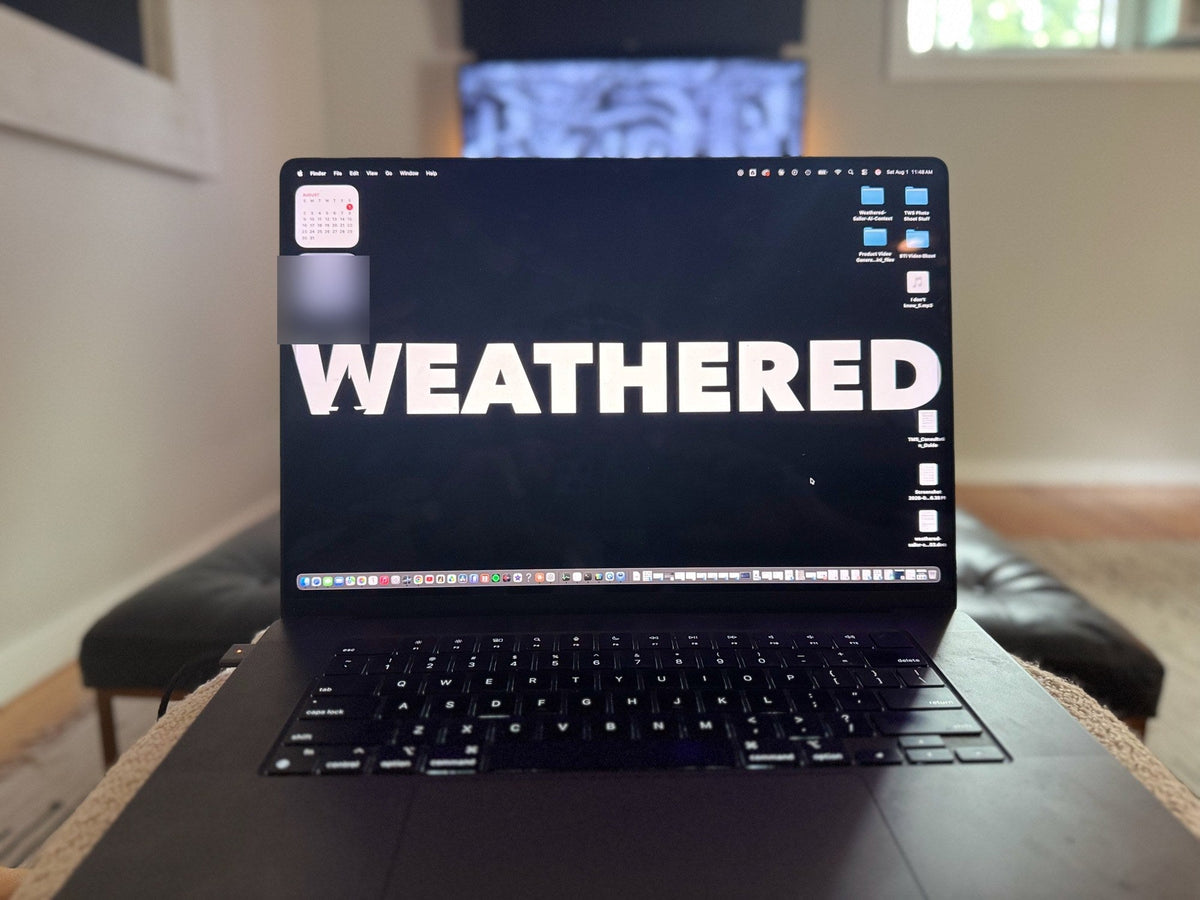
It's Saturday. I only know because my phone told me.
Somewhere in the last couple of years, weekends quietly stopped existing for me. And the strange part is I don't really miss them.
Not because I grind seven days a week like it's a personality. Because the line between a “work day” and an “off day” just dissolved. What's left is time — blocks of it, one after another, and every one is mine to decide what it's for.
I got curious about whether the weekend thing is even real or just something I tell myself. Turns out it's real, and someone measured it. A group of researchers tracked people's moods day by day and found a genuine lift from Friday evening through Sunday — better mood, more energy, fewer aches (Ryan, Bernstein & Brown, 2010). But the part that stuck with me is why. The lift wasn't really about being off the clock. It was mostly about two things: autonomy — doing what you actually chose — and being around people you actually wanted to be around.
Which made me wonder if the reason a Tuesday and a Saturday feel the same to me now is that I already get the Tuesday version of that autonomy. The researchers don't prove that — they're honest it's an open question — but they do float the idea that if your everyday work already gives you that freedom, the gap flattens out, and that a giant swing between your workweek and your weekend might be a quiet signal that something about the job is off. Make of that what you will. Mine used to be huge. I've just noticed it got small.
So what do I do with all these identical blocks? Depends on the day. Sometimes I decide it's another grueling solo stretch, the kind nobody sees and nobody pays me for. Sometimes I take the golf invite, or grab coffee with my sister, or drive down to see my parents, or finally knock out the house projects I know have been quietly stressing my wife out. Same block of time. The calendar can't tell the difference. The only difference is what I point it at.
Apparently there's a whole theory that this is a basic human thing — that autonomy sits right next to connection and competence as one of the few needs we're genuinely wired for (self-determination theory, if you want to fall down that hole). And economists have found self-employed people tend to report higher job satisfaction than employees, even after you account for the inconvenient facts that we often make less and work more — mostly because of the autonomy (Benz & Frey, 2008). Though I'll be first to admit the people who go do this are the ones who wanted the autonomy to begin with, so — grain of salt.
None of it's free, either. Every choice trades against something — output, or sleep, or my head, or my body, or the people I love. So I've started treating it like an experiment: pick how I spend the block, watch how it lands, adjust next time. Some things work. Some really don't.
There's even a name for the two ways people run this: “segmenters,” who wall work off from life, and “integrators,” who blend the two into one blurry thing. The research I came across says neither one is actually healthier — what matters is whether your style matches what you actually want (Kreiner, 2006). Which, for me, is sort of the whole point. It's not the blending that gets you. It's blending without meaning to.
And I won't pretend it's all freedom and fresh air. Some weekends this is a genuinely uncomfortable way to live — unstructured, unpaid, no boss and no Friday to tell me I've earned a damn break. Here's the one that stung a little when I read it: there's a study of knowledge workers who got the freedom to work whenever and wherever they wanted, felt more in control because of it — and ended up working more, not less. They called it the autonomy paradox (Mazmanian, Orlikowski & Yates, 2013). The freedom quietly became the leash. I've lived that weekend. More than one.
So no, I haven't cracked it. But the whole thing seems to work on exactly one condition: that I stay awake to the life I'm actually choosing. Weekends didn't disappear on me. I just stopped letting the calendar decide how I live — which means the deciding is on me now, every block, for better and worse.
Some of those blocks are the loneliest work I've ever done. And in some of them I've never felt more alive, or more in control of the life I'm in and the one I'm building toward.
Anyway. It's Saturday, I think. I've got a block of time in front of me. Going to go decide what it's for.
The reading, if you're curious:
- Ryan, Bernstein & Brown (2010), “Weekends, Work, and Well-Being,” Journal of Social and Clinical Psychology.
- Ryan & Deci (2000), self-determination theory, American Psychologist.
- Benz & Frey (2008), “Being Independent Is a Great Thing,” Economica.
- Kreiner (2006), work–home segmentation/integration fit, Journal of Organizational Behavior (concept from Nippert-Eng, “Home and Work,” 1996).
- Mazmanian, Orlikowski & Yates (2013), “The Autonomy Paradox,” Organization Science.