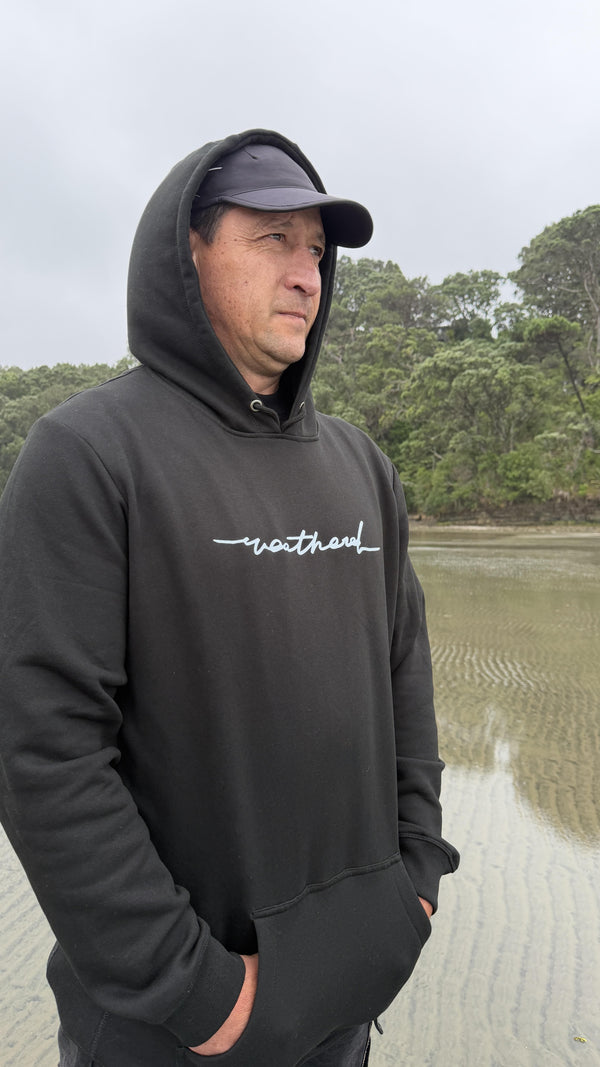
When you run a business alone, you don't get to skip the finance team. You just get to be it — the CFO deciding what a thing should cost, the bookkeeper who's supposed to know where the money went, the pricing analyst, the ops manager. All of those jobs still exist. There's just nobody in the chairs but you, usually late, usually tired, usually doing it by feel.
So the finance function didn't get done badly. It collapsed into something smaller: gut instinct, plus whatever single dashboard I had open that day. I told myself I was on top of the numbers. What I was on top of was one screen's worth of them. I was guessing at the rest.
I ran Weathered Sailor that way for a long time.
The problem isn't effort. It's that your money-truth is scattered.
Revenue lived in my storefront. The real cost to make a product lived with my print partners, one order at a time. The cost of the material underneath it lived somewhere else entirely — with the partner that supplies my materials, drifting on its own schedule, never asking me. Each system was honest. Each was also blind to the others — every one accurate, none of them complete.
No single screen could tell me whether I actually made money on a thing I sold, because the answer was split across the storefront and every supplier, and I was the only one holding all the pieces. Mostly I held them in my head. Sometimes I didn't hold them at all.
That's the real trap. Not too little work. Too many rooms, and no doorways between them.
The move: build the doorways
The fix wasn't automation for its own sake. It was building connective tissue — a way for information to flow freely between platforms that were never designed to talk to each other.
I've built an operating system to run this store with more rigor than a solo founder usually gets to. I'd already pointed it at the storefront, the imagery, the SEO. The money was the part I'd left running on faith. So I connected it — my storefront, my print partners, my materials partner — into one view. It reads the truth out of every one of those systems. And where I choose, it doesn't just look — it acts: it can change a price, fix a listing, or correct product data, directly, in seconds. Never blindly. Every write is one I approve, that's logged, and that I can undo, because it keeps a snapshot I can roll back to.
And once the truth can flow, one person can start asking the questions that used to require a whole team. Where do I actually make money? Which costs drifted? What's mispriced? What's invisible because it's split across three tools? I didn't get a CFO's answer by hiring a CFO. I got it by making my own systems legible enough that one person — me — could finally see all of them at once, and fix what I found without waiting on anyone.
What the first questions actually returned
Here's what fell out — because the point isn't the tooling, it's what became answerable.
A margin I'd recorded was about eleven percentage points too generous. One product looked healthy based on the cost I'd first written down. But the material underneath it had quietly gotten more expensive after I recorded that cost — the way supplier costs drift, no announcement, just a number changing in a system I wasn't looking at. The margin I thought I had was overstated by roughly eleven points. The storefront knew the price. The supplier knew the cost. Neither one knew the margin — that only showed up the second I put them in the same room.
A belief I'd been operating on turned out to be wrong. I assumed a certain slice of my catalog was large and healthy, from one partner. When the data flowed, it was actually tiny and thinner than I'd thought — and most of what I'd filed under that partner was really a different partner's work, misfiled by a naive assumption my own tooling had made. Joining the systems didn't just find a cost. It corrected a belief I'd have kept running the business on.
A whole category had no cost record at all. An entire line of products — non-apparel accessories — had never had its costs written into my operating data. Invisible to any margin question I could ask. Not mispriced, not underwater: unseen. Pulling in its real costs put a category I'd been flying past on the map for the first time.
And pricing landed on a real floor instead of a guess — and got fixed in the same breath. One item, it turned out, was priced barely above what it costs to make. The system didn't just show me that in seconds; I corrected the price through the same layer, right then — a governed write I approved, logged, with a snapshot I could roll back if I'd gotten it wrong. See it and fix it in one motion — no second tool, no waiting. The distance between noticing a problem and correcting it used to be a someday-task on a list. Here it was seconds. Another item looked underpriced — and I chose to keep it accessible anyway, on purpose, and left it exactly where it was. The goal was never to squeeze every line to the maximum. It was to decide each one with my eyes open instead of guessing in the dark, and to be able to act the moment I decided.
The honest boundary
What's live today is finance operations with real rigor — margins, cost drift, classification, pricing — in one view, with the ability to write approved, reversible corrections back. That part is real and running now.
My books of record and my taxes are not connected, and that's on purpose — I don't have enough research or a clear enough outcome there yet, so I'm not pushing there. Someday I may build an early-warning layer that catches a question worth taking to a professional before April turns into a scramble. Its job would be to surface the question earlier — not to answer it, file anything, or move money. This isn't an accountant, and it isn't going to become one that makes financial or tax decisions by itself. A licensed professional still decides what the facts mean and what to do about them. The point was never to replace that person's judgment. It's to bring them a better question, sooner.
What it actually enables
None of this is the clever part. Anyone patient enough can wire a few systems together — the connection itself was never the hard part. What's hard to copy is underneath it: a business's own true costs and live feeds, all in one place, getting a little more complete every week. The tools depreciate. The truth compounds.
And this margin work is just one entry in a larger pattern. It let me scale my own judgment without hiring for it — I stopped spending my day carrying information by hand between rooms. I make decisions on the whole picture now instead of on whichever dashboard happened to be open, which quietly frees my attention for the things only I can do: the brand, the product, the mission.
That mission is the same one it's always been. 1% of every order supports To Write Love On Her Arms, Active Minds, and NAMI. The clearer I can see the money, the more of it I can steward toward that.
The anchor, for us, has always been the same idea: invest the time to see clearly and do the work — whether that's your own life or your own margins. I ran mine on faith for a year. I don't have to anymore. I'm still the finance team — I just finally gave it a way to see.
Weathered Sailor makes good goods for good.