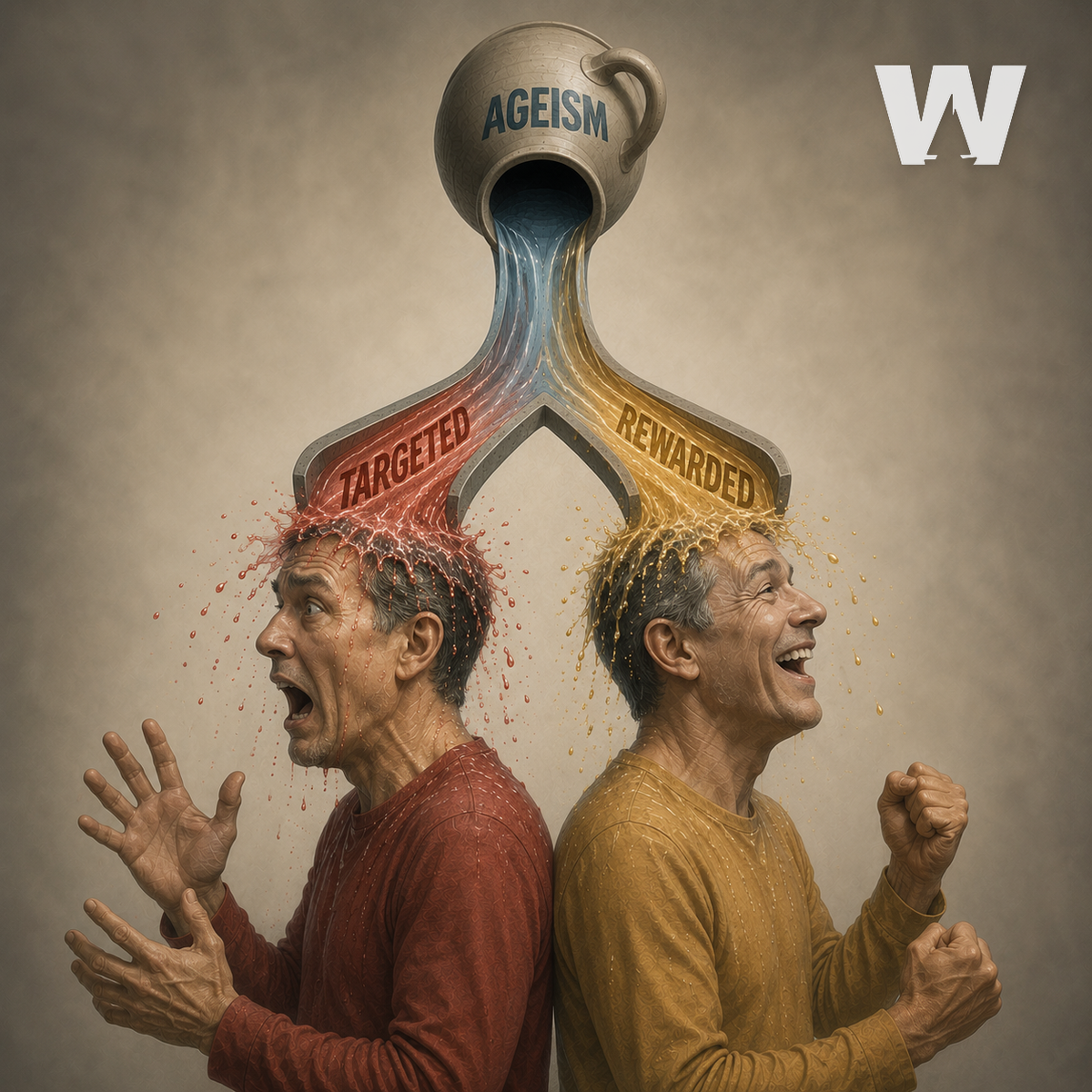
A couple years ago I argued with someone — accomplished, a generation ahead of me — who’d just been laid off and was sure ageism was the reason. I disagreed, and not graciously. Here’s what I can’t get out of my head now: if the timing had broken a little differently, she’d never have been in that layoff. She’d have been in a voluntary buyout — paid, thanked, sent off — for the exact same years of experience she was certain had just gotten her purged. Same person, same career, same age. One coin-flip of timing between “discrimination” and “reward.” And honestly? I don’t know which way I’d have read it if the coin had landed on my side instead of hers.
The exchange itself wasn’t much. It ran a couple days on LinkedIn and then it was over. She had no interest in my read of it, and I had maybe half an interest in hers — I was busy being annoyed. I thought she wasn’t accounting for the luck and the runway she’d already had, and I let that thought do most of my talking. I’ve softened since. The argument didn’t end because either of us won. It ended because that’s what those arguments do. It only came back to me recently, while I was writing, because the world handed it a sequel.
Here’s the sequel. This year Microsoft announced its first voluntary retirement program in the company’s history — a “Rule of 70” buyout aimed squarely at long-tenured, older employees: weeks of pay per year of service, years of healthcare, a thank-you on the way out. You can read it generously, as a soft landing for people who earned one. You can also read it, as one outlet did, as “a buyout dressed as a benefit” — a quiet way, on that reading, to thin the senior ranks without the optics of a layoff. Both readings can be true at once. That’s the part that gets me.
Because the trait being paid for is the exact trait people swear gets them purged. Experience. Years. Age. The AARP says roughly two-thirds of workers over 50 have seen or felt age discrimination on the job, and I don’t doubt a minute of it. It’s not evenly distributed — women tend to get hit with it earlier and harder, sometimes the moment they hit their 50s. It can look like a woman called “past her prime” at an age a man gets called “seasoned.” So when she told me ageism took her job, she might have been right. I want to hold that honestly, not as a rhetorical setup. If I’d had her years on the same morning, I’d probably have felt exactly what she felt.
Here’s where my thinking on this lands right now, and I’ll put myself first in line: most of us aren’t against bias. We’re against bias when it costs us.
When it takes from us, we’re sure we didn’t deserve it. When it pays us — for the exact same trait — we’re certain we deserve it. Same variable, read as robbery one season and reward the next. When age counts against us we call it discrimination. When it counts for us we call it comp for a job well done, and we cash the check. I’ve stood on both sides of that line. The question I can’t shake isn’t which reading is right. It’s why the outrage only ever runs one direction.
The law almost winks at it. A buyout aimed at older workers isn’t a loophole — it’s a paved road. Federal rules even build in protections for these exit packages: extra consideration time, a revocation window, written advice to talk to a lawyer. The same age that’s a liability in a layoff becomes a qualification in a buyout, and we’ve written the statutes to make the second one feel like care. I’m not mad about that. I’m just noticing that the line between being targeted and being rewarded is mostly a matter of which envelope shows up.
I want to be fair to my younger self too, the one in that argument, because he wasn’t all wrong. Plenty of people do underestimate their own luck. The runway you got handed is the hardest thing in the world to see from inside it. But I was doing the same thing I was accusing her of — reading one generation’s hardship as somehow less load-bearing than my own. I think we all do this constantly, and I think it shows up most clearly in America at work, more than almost anywhere else. The boomers I know quietly suspect my generation is soft and got it easy. My generation quietly suspects theirs pulled the ladder up. The entry-level door has gotten measurably narrower over the last couple years, and the senior door has its own set of locks. Everybody’s standing at a door that won’t open and assuming the people at the other doors walked right through.
I don’t have the policy answer. I’m not sure there’s a clean one. What I’ve actually got is smaller and more personal: I got laid off a few years back, and for a while I read it as a verdict on me. It wasn’t. The life after it has been better than the one I was protecting — not because the loss didn’t hurt, but because the story I’d told about what the loss meant turned out to be the heavier thing to carry. My body had already filed it under threat. The reflex to make it mean something about my worth was the part that actually needed unlearning, long after the job was gone.
So I’ll keep the question instead of pretending I’ve solved it. When the same fact takes from you, it’s an injustice. When it pays you, it’s a reward you earned. We’re all running that math, all the time, and almost never catching ourselves doing it.
What’s your read — and which way do you think the coin would’ve landed for you?
References
Microsoft plans first voluntary retirement program for US employees. (2026, April 23). CNBC. https://www.cnbc.com/2026/04/23/microsoft-plans-first-voluntary-retirement-program-for-us-employees.html
Perron, R. (2026). Age discrimination holds steady among older workers in 2025. AARP Research. https://www.aarp.org/pri/topics/work-finances-retirement/employers-workforce/age-discrimination-workplace/
SignalFire. (2025). The SignalFire state of tech talent report — 2025. https://www.signalfire.com/blog/signalfire-state-of-talent-report-2025
Stan, A. M. (2026, April 23). Microsoft’s first voluntary retirement offer is a buyout dressed as a benefit. The Next Web. https://thenextweb.com/news/microsoft-voluntary-retirement-us-workers-ai
U.S. Equal Employment Opportunity Commission. (2009). Understanding waivers of discrimination claims in employee severance agreements. https://www.eeoc.gov/laws/guidance/qa-understanding-waivers-discrimination-claims-employee-severance-agreements
U.S. Equal Employment Opportunity Commission. (2024). Older women at work: The intersection of age and sex discrimination. https://www.eeoc.gov/sites/default/files/2024-09/Older%20Women%20at%20Work%20%E2%80%93%20The%20Intersection%20of%20Age%20and%20Sex%20Discrimination_0.pdf