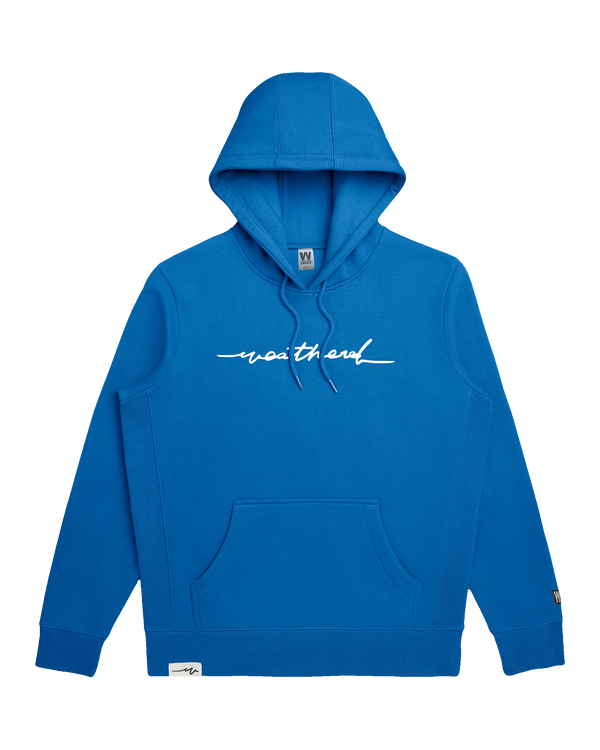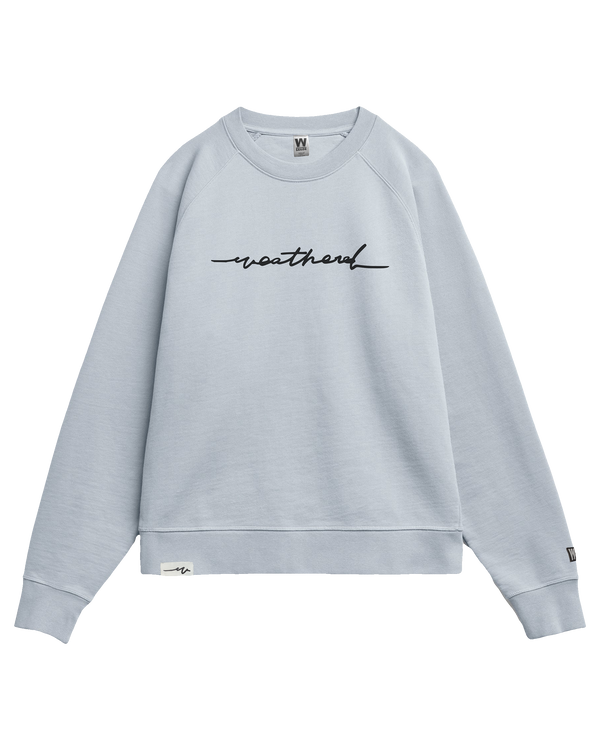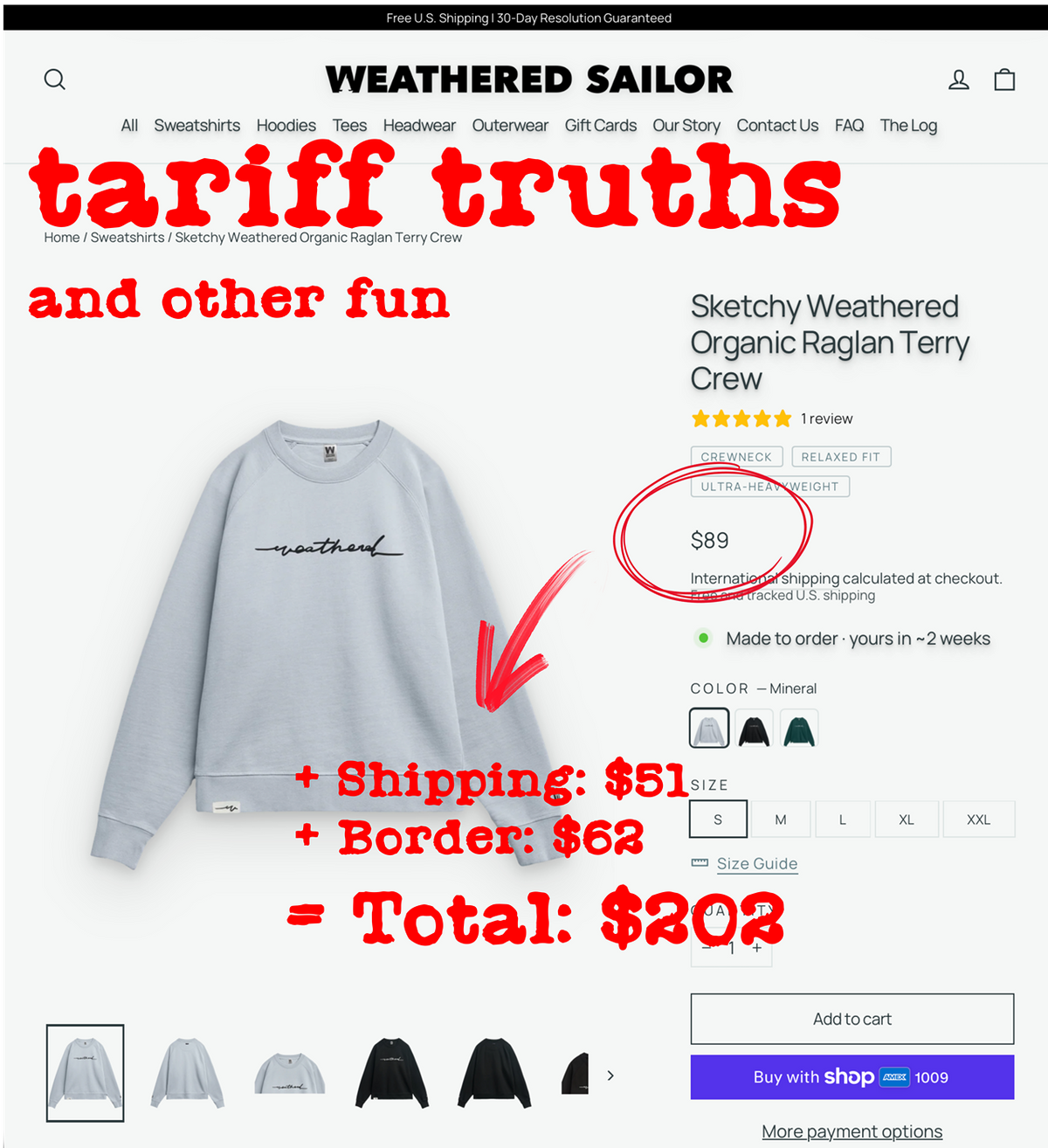
A customer in Canada wanted one of our sweatshirts — the Sketchy Weathered organic French terry crew. Eighty-nine dollars. A fair price for what it is.
By the time it reached her door, that eighty-nine-dollar sweatshirt had cost two hundred and two.
Here’s the math, because the math is the whole point. The crew was $89. Shipping to Canada ran about $51 for roughly five business days. And then, after the package crossed the border, she got the message every cross-border shopper dreads: to actually receive the thing she’d already paid for, she owed another $62. Eighty-nine dollars of product. One hundred and thirteen dollars of everything else. More than double the price of the item, for costs that had nothing to do with the item.
She didn’t want a sweatshirt anymore. She wanted her money back, and she wanted out of an experience that had turned sour — an experience she’ll understandably file under the name on the box. Mine. Weathered Sailor’s. So I did the only thing that felt right: I told her I’d cover it. I ate the border charge so she wouldn’t be punished for buying something from a small American brand. Which means a small business paid for the production of the product and the cost of getting it across the border, and turned a sale into a loss. Negative revenue, on a single sweatshirt.
First, the honest part — because it’s what earns the rest
I’m not going to hand anyone a reason to wave this away, so let me be exact about that $62. It was not a U.S. tariff. It was Canada’s own sales tax on the import, any applicable duty, and the courier’s brokerage fee for fronting those charges at the border. Ordinary cross-border friction, levied by another country, and I won’t pin it on Washington to make a cleaner story. If you ship a parcel across any border right now, some version of this is waiting on the other side.
I lead with that because I want you to trust the numbers I’m about to give you. I’m not reaching. I’m not spinning one bad day into a grievance. Everything past this line is documented, sourced, and looks the same no matter who you voted for.
Now the part that is a decision, not weather
Weather isn’t decided in a room. This was. Over the course of 2025, the United States raised tariffs to the point that the average effective tariff rate is now, by the Budget Lab at Yale’s accounting, the highest it has been since 1935 — an average effective rate of 14.8%. Not in a few years — since 1935. And clothing — the exact category I build in — is among the hardest hit: the same source puts the short-run price increase on apparel at 21%, settling around 6% over the long run.
Here is the line that reframes the argument about who pays for that. The Federal Reserve Bank of New York measured it directly: through November 2025, Americans — U.S. companies and U.S. consumers — paid for nearly 90% of the tariffs. Foreign exporters didn’t absorb them. We did. That is not my opinion, and it is not a talking point. It is the New York Fed, reading the actual import data. The bill lands here, on businesses and buyers inside these borders.
And the specific rule that used to let small cross-border orders move without a customs ordeal — the de minimis exemption on low-value shipments — wasn’t eroded by market forces. It was ended by a signed executive order, on a specific date, as a specific choice. For a brand my size that brings in materials and blanks to make the things we sell, that choice has a dollar figure, and I pay it every time.
So this is what I mean by decision, not weather. My costs went up to make the thing. My customer’s costs went up to receive the thing. And I’m standing in the middle absorbing whatever I can so the person on the other end doesn’t walk away hating me. None of that fell out of the sky. It was chosen — on the record, by the current administration — and you can look up every number in this post.
What a tariff is actually for
I went and reminded myself what tariffs are even supposed to do, because I wanted to argue in good faith. In theory, they’re a protective tool. They exist to guard a country against real threats: foreign companies dumping product below cost to kill a domestic industry; competitors propped up by foreign government subsidies; the erosion of strategic industries like steel or semiconductors; intellectual-property theft; wages and standards undercut by exploited labor abroad. Those are legitimate things to protect. I’m not anti-tariff in principle. A tool has a purpose.
Which is exactly why I keep getting stuck on a simple question: when the tariff bill lands almost entirely on Americans — nearly 90% of it, per the Fed — who, exactly, is being protected, and from whom? When the friction lands not on some predatory mega-competitor but on a Canadian woman buying one sweatshirt, and on the tiny American brand that made it, the tool is not doing the job it was built for — at least not for people at my scale. Whatever it’s protecting, it isn’t us, and somebody still has to carry the cost.
The part that doesn’t make it into the announcements
Here is the part that gets left out. When these costs land, they don’t vaporize at the top. They roll downhill and pool at the bottom, on the businesses least able to absorb them. The consequences are real, and they’re easy to miss from the top:
You compress your margin until you have to raise prices, and then you lose the customers the price increase scared off. You eat costs you didn’t create to protect a relationship, and call it the cost of doing business. You watch a customer’s bad experience get filed under your name, even though you didn’t set a single one of those fees and couldn’t have stopped them. You quietly give up on entire international markets because the checkout math stopped making sense. You burn hours you don’t have learning customs codes and origin rules instead of building the business those hours were supposed to grow. The big players adapt — they have trade lawyers and bonded warehouses and whole departments for this. The small ones just carry it.
And this was one purchase, of one product. At full scale, the impact is plainly far more dangerous to a business like mine unless conditions change soon and significantly. One sweatshirt was a story I could afford to absorb. A thousand of them is not a story. It’s a closure.
The weight you’re not supposed to mention
There’s a piece of this that’s harder to put a number on. Building a business is already a daily act of nerve — and a lot of us are doing it while carrying our own mental-health load underneath the spreadsheet. Every one of these surprise costs isn’t just a line item. It’s another weight on a stack a lot of owners are already carrying, mostly in private.
And there’s a second weight stacked on the first: the discomfort of even writing this. We’re in a moment so divided that saying out loud “this policy is materially hurting my small business” feels like stepping into traffic, no matter how carefully you say it. So a lot of owners just… don’t. They swallow it. And the silence means the real, unglamorous, kitchen-table cost of it rarely reaches the people who could change it.
I want to be clear about what this is and isn’t. This isn’t a partisan post, and I’m not interested in scoring points for a side. It’s a post about logic, and truth, and the real impact of real decisions on real people trying to make an honest thing. Every hard number in here comes from the Federal Reserve, from Yale, or from the government’s own signed orders — you can check every one. I’m sharing it in the one place built for exactly this kind of conversation — a professional community — in the genuine hope that someone reading has found a workaround I haven’t, or a better way through, or just recognizes their own week in mine. That’s how real change starts: somebody says the quiet number out loud, and someone else says me too, here’s what I tried.
Two hundred and fifty years, from a kitchen table
I wrote most of this over the Fourth of July weekend — the 250th one. Two and a half centuries since a few people staked a whole country on a radical idea: that ordinary people should be free to build a life and chase something of their own. The pursuit was the entire point — not a guarantee you’d catch the thing, just the room to go after it honestly.
And I’ll be honest about where my head was, on the weekend built to celebrate exactly that. Not on fireworks. On how hard the conditions I just walked through are making it for the very people this country was written for — the ones trying to build a small, honest, hopeful thing with their own hands. A 250th birthday should have been a weekend about that pursuit. Instead I spent it doing the math on why the pursuit keeps getting more expensive — literally taxed, one sweatshirt at a time. A quarter of a millennium in, the idea still sells fine. It’s the going-after-it that keeps getting harder, for the exact people the whole thing was supposed to be for.
None of this changes what I’m going to do tomorrow, which is get up and keep building. But I’d be lying if I pretended the ground felt level right now. It doesn’t. And a country that calls small business its backbone should know what it actually costs to be one. Underneath all of it, the harder stuff is the reason this brand exists in the first place: 1% of every order supports To Write Love On Her Arms, Active Minds, and NAMI. The real work happens in places we’re not qualified to be.
If you’re building something too, and you’ve felt this — I’d genuinely like to hear where you’ve landed. What’s worked. What hasn’t. What you wish someone had told you before the border did.
Sources
State of U.S. Tariffs: January 19, 2026. The Budget Lab at Yale. https://budgetlab.yale.edu/research/state-us-tariffs-january-19-2026
Who Is Paying for the 2025 U.S. Tariffs? Liberty Street Economics, Federal Reserve Bank of New York (February 2026). https://libertystreeteconomics.newyorkfed.org/2026/02/who-is-paying-for-the-2025-u-s-tariffs/
Suspending Duty-Free De Minimis Treatment for All Countries (Executive Order 14324, July 30, 2025; effective August 29, 2025). The White House. https://www.whitehouse.gov/presidential-actions/2025/07/suspending-duty-free-de-minimis-treatment-for-all-countries/